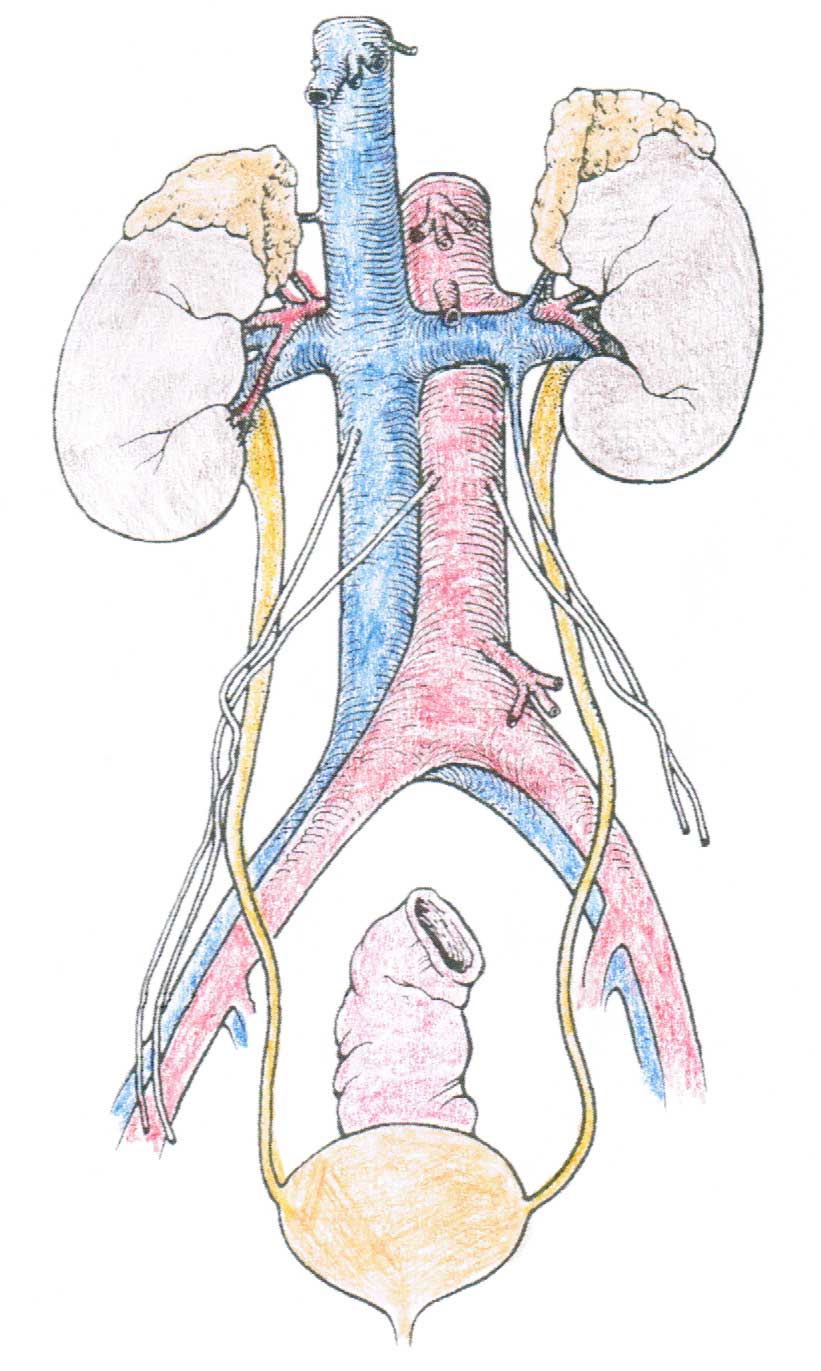
This image shows the kidneys, ureters, and bladder. The adrenal glands (part of the endocrine system) sit on top of the kidneys and release renin which affects blood pressure, and sodium and water retention. The bean-shaped kidneys are about the size of a closed fist. They lie against the back of the abdominal wall, outside the peritoneal cavity, just above the waistline in the lumbar area. The right kidney sits slightly higher than the left one because of the position of the liver. The kidneys are aout 4 1/2 inches long and 2 1/2 inches wide. The kidneys are highly vascular (contain a lot of blood vessels) and are divided into three main regions: renal cortex (outer region which contains about 1.25 million renal tubules), renal medulla (middle region which acts as a collecting chamber), and renal pelvis (inner region which receives urine through the major calyces).
The kidneys are protected in front by the contents of the abdomen and behind by the muscles attached to the backbone. They are further protected by a layer of fat.
Kidneys – collect the body’s waste products andUreters – Muscular tubes that transport urine from each kidney to the bladder.Urinary Bladder – A sac that collects and holds urine that comes from the ureters.Urethra – a narrow passageway where urine passes from the bladder to the outside of the body, called urination.

Every minute 1300 mL of blood enter the kidneys, 1299 mL leave the kidney. and 1 mL leaves as urine.
The kidneys have many functions. The kidneys are the major organs that maintain homeostasis (balance of the various body functions) in the body and help control blood pressure. They maintain balance in electrolytes, acid-base, and fluid in the blood. The kidneys remove nitrogenous waste from the body (creatinine, urea, ammonia) and keep essential substances the body needs to function as it should. The kidneys produce the hormone erythropoietin that stimulates the production of red blood cells and enzymes.
When the kidneys aren’t working as they should, there is a failure of homeostasis which can cause death if not corrected. A panel of blood tests, called a Kidney Function Profile, is used to monitor the kidneys, detect kidney problems or make a diagnosis.

Renal Artery – brings waste-filled blood from the aorta to the kidney for filtering in the nephron. Glomerulus – each glomerulus is a cluster of blood capillaries surrounded by a Bowman’s capsule. It looks similar to a ball of tangled yarn.Proximal convoluted tubule (PCT)Thin descending limb of the loop of HenleThin Ascending limb of the loop of HenleThick Ascending limb of the loop of HenleDistal convoluted tubuleRenal Vein – when filtration is complete, blood leaves the nephron to join the renal vein, which removes the filtered blood from the kidneyArterioles – blood is brought to and carried away from the glomerular capillaries by two very small blood vessels—the afferent and efferent arterioles. Bowman’s Capsule – Surrounds the glomerulusGlomerulus – consist of a the cluster of capillariesProximal Convoluted Tubule – nearest the glomerulus; have permeable cell membranes that reabsorb glucose, amino acids, metabolites and electrolytes into nearby capillaries and allow for circulation of waterLoop of Henle – has an ascending and descending limb, these loops along with their blood vessels and collecting tubes for the pyramids in the medulla. When the filtrate reaches the descending limb of the loop, water content has been reduced by 70%. The filtrate contains high levels of salts (mostly sodium). As the filtrate moves further through the loop, more water is removed which further concentrates the filtrate.Distal Convoluted Tubule - farthest from the glomerulus; helps regular potassium excretion.Collecting Duct – collects the filtrat.
Individual nephrons cannot be seen by the naked eye.
The nephron is the basic structural and functional unit of the kidney. Each kidney has about 1 million nephrons. The walls of the nephron are made of a single layer of epithelial cells. Blood containing urea and metabolic waste products enters the kidney from the liver. The blood is mechanically filtered to remove fluids, wastes, electrolytes, acids and bases into the tubular system while leaving blood cells, proteins and chemicals in the bloodstream. The nephrons also reabsorb and secrete ions that control fluids and electrolyte balance.
The blood enters the kidney and goes to the glomerulus. Pressure forces fluid out of the blood through membrane filtration slits creating a cell-free fluid (plasma) of water and small molecules that enters into the renal tubule. Large cells and proteins stay in the blood. This plasma is taken to the nearest (proximal) convoluted tubule. This runs down into the medulla into the loop of Henle and then back to the farthest (distal) convoluted tubule to join with other tubules. In the distal tubule most of the salts are reabsorbed. What is left is further modified until it becomes concentrated urine which contains urea and other waste products at the end of the collecting duct.The kidneys collect and get rid of waste from the body in 3 steps:
Glomerular filtration – Filtrate is made as the blood is filtered through a collection of capillaries in the nephron called glomeruli.Tubular reabsorption – The tubules in the nephrons reabsorb the filtered blood in nearby blood vessels.Tubular secretion – The filtrate passes through the tubules to the collecting ducts and then taken to the bladder.The glomerular filtration rate (GFR) is the rate at which the glomeruli filter the blood. The normal GFR is 120 ml/minute. The most accurate measure of the GFR is done by measuring creatinine clearance. Clearance is the complete removal of a substance from the blood. Creatinine is a good measure because it is filtered by the blood but not reabsorbed by the tubules.Urine is made of water, urea, electrolytes, and other waste products. The exact contents of urine vary depending on how much fluid and salt you take in, your environment and your health. Some medicines and drugs are excreted in urine and can be found in the urine.
94% water3.5% urea1% sodium*.5% chloride*.25% potassium*.25% phosphate.25% sulfate.15% creatinine.1% uric acid*Electrolytes
What is in urine is not as important as how much urine is made or how the amounts of the individual components change in order to keep the body in balance (homeostasis). This balance is done in the kidneys, no matter how much we eat or drink. The kidneys keep this balance by reworking the blood 15 times a day. If the body is dehydrated, the kidneys put less water is in the urine. When the body becomes too acid, the kidneys remove more acid into the urine. If the potassium levels get too high, the kidneys remove more potassium into the urine.
Urine is formed in the nephrons in three process: glomerlular filtration, tubular reabsorbtion and tubular secretion. The amount of urine varies based on fluid intake and climate.

No comments:
Post a Comment