Tuesday, 5 February 2013

Ice Cream for Baby - An Easy Recipe to Make Ice Cream That's GOOD for Your Baby!


Unfortunately, though, regular ice cream is NOT an ideal food for your baby's first year.

It's often loaded with sugar, artificial flavours, artificial colours and unhealthy fats - and whilst fats may not be too much of an issue at this stage of your child's development, the taste preferences you encourage now may stay with your baby throughout life.

That's why it's SO important to introduce him to the healthiest options at this early stage.

So how about if we told you there's an ice cream for baby that... is loaded with the HEALTHY fats your baby needsis dairy freecontains NO SUGARcan be prepared in minutestastes truly delicious

Sound too good to be true?

Well, here it is... a mouth-watering, fruity ice cream that's not only SAFE for your baby, but GOOD for him too! Healthy Ice Cream for Baby

Containing all the benefits of healthy avocado, this luscious blend is sweetened by banana, has a wonderful hint of coconut and pops with flavour from the strawberries. All of our children - tots to teens - LOVE it!

2 ripe bananas, peeled and cut into chunks
1/2 Hass avocado, pitted and cut into chunks
5 large ripe strawberries, hulled and halved
1 tsp vanilla extract (optional)
1/3 cup (around 3 fl oz) unsweetened coconut milk
2 tsp coconut oil

Smoothies for Babies - Delicious and Nourishing

They're particularly useful for babies who have problems accepting textured foods and are perfect for little ones who might refuse the ingredients in their 'whole' form... but will slurp away happily when blended into a creamy (and hard to identify) consistency!

These wonderful recipes were submitted by our readers, whose babies are already enjoying these creative concoctions!

Please note: The comments that accompany these recipes are from the parents who sent them in. We recommend that you should always discuss the introduction of any new foods with your child's doctor.

Some of these recipes contain berries. Some babies react to strawberries, raspberries or blackberries, so you may wish to wait until your baby is at least 12 months before introducing those particular recipes. Blueberries, however, are far less likely to cause any reactions.

Smoothies for Babies - Single Serving Fruit Porridge Smoothie

From Aysha in the US

1/4 cup (1 oz) uncooked oatmeal
1/4 cup (2 oz) fresh blueberries (or other berry)
2 tbsp apple juice

1. Place dry oatmeal in blender to break it up.
2. Once oatmeal looks almost like dust, pour in the berries and juice(s).
3. Blend again until berries are chopped up and everything is well mixed and it looks like a smoothie.
4. Now pour mixture from blender to a cup or bowl for your baby to enjoy. Makes one serving.

Smoothies for Babies - Indian Mango Lassi


From Michael in the United States


one whole mango
half cup (4 oz) of plain organic yogurt.
a pinch of nutmeg (or cinnamon)
quarter of a cup (2 fl oz) of organic milk.
half a table spoon of sugar (note from editor - although we understand that sugar is commonly used in making lassi, we recommend omitting it when making lassi for your baby)

You will need a large bowl, a blender, a sharp knife, and a whisk.

1. In the large bowl, pour in the organic yogurt, milk, nutmeg, and sugar (if using).
2. Whisk until all ingredients are well-mixed and fully incorporated together.
3. Add this mixture into your blender.
4. Peel the mango and strip the flesh off the pit. Put this flesh into the blender.
5. Puree until the mango is fully combined with the mixture.

Mesh Feeder For Baby Finger Foods

The thought of offering your baby a piece of food to hold and bite for himself can be a scary one... after all, you've probably been carefully controlling the texture of his food up to now, particularly the size of the pieces he puts into his mouth. Benefits of a Mesh Feeder

Mesh feeder

stops baby getting 'lumps' of food in his mouthis ideal for teethinghas a 'chill' feature to keep food coolcomes with a storage capcan be used to serve breast milk popsicles!gives great value for money!You may fear that he will - quite literally - bite off more than he can chew, or have trouble 'gumming' the food to the point where he can swallow it.

In fact, we tend to under-estimate our babies' abilities when it comes to dealing with finger foods. Most babies manage perfectly well, some with no teeth whatsoever. Our little ones would usually eat what they could, then simply spit out any tougher pieces or - in the case of certain fruits and veggies - bits of skin.

Nevertheless, the fear may persist. And if you find it's holding YOU back in allowing your baby a little independence at mealtimes, then why not consider using a mesh feeder, sometimes known as a teething feeder?

A mesh feeder is simply a little mesh bag with a handle. You put baby's food into the bag (ideas include raw apple, chunks of banana, frozen blueberries or grapes), then seal it up and give it to your baby.

Your little one can then use the handle to hold on and gnaw away at the bag, creating his own 'puree'.

And the 'puree' is all that will get into his mouth - any peel, seeds or lumpy bits will remain in the bag!

Ideal from around 5 months onwards, the feeder... helps you introduce finger foods WITHOUT the worry!is great for a teething baby - just fill with frozen fruit and all that gnawing will numb baby's gums, stopping the pain (AND the tears!).has a 'chill' feature in the handle, keeping food cool and therefore safe for baby.comes with a storage cap for mess free travel.can be used even BEFORE your baby starts solids... it's a great way to serve breast milk popsicles!is one of those invaluable baby accessories that costs very little but gets used over and over again!

View the original article here

Monday, 4 February 2013

Homemade Food Coloring and Natural Food Dyes

There are - as yet - no studies that categorically prove artificial food colors and dyes are harmful. But there ARE studies that give cause for concern, suggesting that synthetic food dyes may contribute to conditions like ADHD and even cancer.


And whilst the governments of some countries will insist that certain food colorings are not harmful to health, those same food colorings have been banned in other countries - a fairly strong indication that their true safety is a contentious issue!

This page is not designed to comment or partake in the controversy surrounding artificial food dyes. However, we as a family have certainly read enough to feel it's in the best interests of our children to avoid them!

After all - our little ones have been brought up on homemade baby food, chiefly to AVOID unwholesome and artificial additives, so we certainly don't want to introduce them for purely cosmetic reasons... and particularly when there are natural, healthier alternatives available!

This page, then, is designed to help you transform the color of your baby's food in safe and natural ways, possibly even increasing its nutritional value too!

Whether you're looking for a natural food coloring for the frosting on baby's first birthday cake, for dyeing Easter Eggs, or you simply want to create some pink quinoa to tempt a picky eater, read on to discover some ways to produce a rainbow of colors WITHOUT introducing unhealthy - and unnecessary - additives!

Important note: If any of the ingredients mentioned on this page are new to your baby, please observe the four day rule to enable you to identify the cause of any digestive problem or reaction. And remember - you should always discuss the introduction of new foods with your child's doctor.

To boil: Simply cover the food with water, bring to the boil, then simmer for around one hour, until the water has become infused with the color. DON'T EAT THE FOOD OR USE IT IN YOUR BABY FOOD RECIPES - it will be nutritionally worthless, as all the nutrients will be in the water!

You can then use the colored water to cook (and thereby color) another food. For example, you could use the water from boiling red cabbage to then cook a batch of brown rice. Hey presto - pinky-purple rice!

Alternatively, you can add the colored water directly to foods like frosting, but it's important to remember that the water produced by boiling fruits and veggies does NOT produce a deep color in the foods it's added to.

Instead, it provides more of a 'hue' or 'tint' - still attractive, but not particularly vibrant (so don't expect to produce a bright red dye for Elmo using this method!).

To juice: Either use your juicer or cook (if necessary) and puree the foods, either with a blender or by pushing through a sieve. This will produce a more vibrant color than using the boiling method (above) as the pigment is not diluted by water.

...So bear that in mind, particularly if you're coloring frosting (icing). If you're using a dye produced by the 'boiling' method, you might need quite a lot... and this could make your frosting runny. If your frosting recipe calls for the addition of any liquid (for example, a confectioner's sugar/water icing), reduce the amount you use to compensate for the dye.

Where too much liquid is an issue, you'd probably be better off using the 'juicing' method, where the color is more pronounced and less is needed.

This really depends on which method you used to make the coloring. Dyes made with the 'boiling' method are very dilute and their flavour is barely noticeable - you could even get away with using red cabbage water as a frosting dye, for example. If you feel you CAN taste your dye, you can easily mask it - in a frosting, a drop or two of vanilla should do the trick!

Natural food coloring made from juicing fruits and vegetables will have a stronger flavour - on the other hand, less will be needed as the color is stronger too.

Although it's a good idea to try to pair sweet dyes with sweet foods (don't forget that foods like beets and carrots are sweet!), it's worth experimenting a little. You may find that you can blend a 'savory' dye with a sweet food and still produce a yummy result!

It's possible to blend fruit/veggies directly with the food you're trying to dye (blueberries with frosting, for example, to get a purple-pink frosting). However, this may give you a 'flecked' look and little bits of skin may be visible. Straining the cooked fruit/veg then using the juice itself with give a smoother result and more even color. So sometimes you can avoid boiling/juicing and straining altogether, and simply stir chunks of food that stain (like beets/beetroot) into the food you want to dye. For example, you can turn mashed potato pink by stirring pieces of cooked beets around in it, then removing them before serving. This avoids making the mashed potato too thin by adding liquid to it. advertisement
If you really want a natural food dye but don't have time to make your own, check out these natural food colorings by India Tree. They're made from vegetable extracts, with no synthetic ingredients.

How to get out of the Lunchbox Rut – Easy, Healthy and Fun Recipes

6

Putting your kid’s lunchbox together can be boring. It involves ticking off a mundane checklist as you quickly fling items in: sandwich – check, fruit or vegetables – check and maybe a biscuit – oh go on then!

A low point was reached the other day. One leftover burger bun from a BBQ the night before covered in a layer of hummus, three slices of cheese and a banana. It was quick and easy but not exactly inspiring. I looked at the mound of beige and yellow inside my son’s Cars lunchbox and as Lightning McQueen grinned away at me I decided to try harder.

My self-imposed mission was to come up with some inspiring ideas that would create a fun lunchbox. The other requirements were that the ingredients had to be included in our weekly food budget, be healthy and could be combined using a quick and simple method.

After some Internet surfing I came across lots of images of really funky kids bento lunchboxes. This is one of my favorite websites: www.justbento.com. It has creative and fun recipes and provides lots of helpful tips. The problem with bento boxes is that while they look awesome they also appear to be expensive, fiddly and time consuming. Just Bento provides options for beginners. Bento box number 74 is not Japanese but it takes just five minutes to assemble and demonstrates some artistic ideas.

The Japanese theme appealed to me so I did some further research and decided to give two sushi style recipes ago. One is from My Recipes and is for coconut frushi and the other is from Domestic Charm and is for a sushi sandwich. These recipes are not traditional but provide an inventive fusion. The coconut frushi is a nigiri style sushi but with coconut milk and not vinegar. Fruit is then placed on top rather than raw fish. The sushi sandwich is just a sandwich presented like sushi but because you can see the contents it is much more visually pleasing.

We had some friends coming over for morning tea so I decided to try the two recipes out to see if they would work well in a lunchbox.

Making use of ingredients we already had would help keep within the weekly budget so I only bought sushi rice (Sun Rice, $3.04 from Pak n Save). I substituted some items in the recipe with what was in the pantry and fridge. My ingredients list was:

1 Ingredients for coconut frushi

1 ¼ cups of water

1 cup of uncooked sushi rice

¼ cup of white sugar

¼ cup of coconut cream

A dash of salt

Coconut oil

Canned blueberries

Plain natural yogurt

Honey

2 Combining the rice, sugar, coconut
cream and salt

I followed the My Recipes recipe, which is:

1. Bring water and rice to a boil in a medium saucepan. Cover, reduce heat, and simmer 15 minutes or until water is almost absorbed. Remove from heat; let stand, covered, 15 minutes.

2. Place rice in a large bowl. Add sugar, coconut cream, and salt, stirring gently until well combined. Cover and let stand for 20 minutes.

3. Lightly coat hands with cooking spray. Divide rice mixture into 20 equal portions, shaping each into a ball (about 1 rounded tablespoon each). Lightly press each rice ball into an oval between palms; place ovals on a baking sheet lined with wax paper. Top each of 10 ovals with 1 orange section, and press gently to adhere. Top each of the remaining 10 ovals with 2 raspberries. Cover and chill frushi until ready to serve. Serve with yogurt for dipping.

I stuck to part one and two just as described. Part three is where I made some changes. I didn’t have cooking spray but found that a very small blob of coconut oil (I am sure olive oil would be just as good) rubbed into my hands worked just fine. Making the rice into balls was tricky so I squashed the rice straight into shape in the palm of my clenched fist. The more you squeeze the better they stick. Putting them onto a non-stick baking tray worked well. I used honey to stick the blueberries onto the rice. Honey can also be added to plain natural yogurt to make the dipping sauce.

3 Ingredients for sushi sandwiches

This time I used the Domestic Charm recipe as a guide as I had different ingredients available. They were:

2 slices of wholemeal bread

4 slices of shaved ham

Two tsp of crème fraiche

All purpose seasoning

8 thin slices of cucumber

To start with I chopped the crusts off the two slices of bread and spread on crème fraiche. I then sprinkled on the all purpose seasoning and placed two pieces of ham onto each slice of bread. Make sure you leave a little bit of space on one edge as this helps the sandwich stick together. I placed four thin slices of cucumber at the other end of the slice of bread and tightly rolled the slices up. I then cut each roll into four pieces so that I had eight in total.

4 Crème fraiche and all purpose seasoning

I was pleased with the outcome of both but although the coconut frushi was easy to make it did take a while to complete. However, if you want to make them for a lunchbox one morning you could do other tasks during simmering and standing times. The sushi sandwiches were very quick and easy and they are a great alternative to the regular sandwich.

Give the sushi sandwiches a go, they are quick, easy, affordable and look great in a lunchbox. You could try lots of different fillings and create some fantastic colour. If y

ou come up with an awesome combination let us all know.

Michelle Kemp

Michelle Kemp is the Author of Two Weeks to Sleep: A Sensible Guide for First Time Parents and soon to be released Little Book of Routines: A Practical Guide for Mums and Dads.

Michelle is married to James and a proud Mum to their son Max. The three of them love spending time together and experiencing new adventures as a family, whether that's just hanging out at the local park or travelling to new and exciting places. Michelle is passionate about helping families build key foundations in their lives. These foundations are quality sleep, a nutrient rich diet and plenty of movement. Michelle believes that these foundations go a long way towards supporting a full and happy family life.


View the original article here

Sugar Free Applesauce and Banana Cake For Baby's First Birthday


This is what was left of it, anyway.


This is what was left of it, anyway.


I did put a little frosting on it for the experience, but it didn't need it for flavor.


I've made this into muffins for him since his birthday, he loves them.


I also like to eat them and my mother in law asked for the recipe! I do NOT recommend putting them into cupcake papers though. They do not come out.

Homemade Infant Cereal - Answers to Your Frequently Asked Questions

IMPORTANT NOTE: This information does NOT constitute medical advice and you should always consult a medical professional before introducing new foods to your baby. It is also important to seek professional medical advice regarding your baby's iron levels.

Commercially produced packets of infant cereal are fortified with iron. Homemade infant cereal is relatively low in iron in comparison.

So does this mean you should avoid giving your baby homemade cereal?

No - it simply means that you shouldn't look on it as a good source of iron and that you should ensure baby receives iron from other food sources.

The exception, of course, would be if your child's pediatrician specifically recommends introducing commercial, iron fortified cereal because your baby needs extra iron (if tests have shown he is iron deficient, for example).

It is extremely important that your baby's iron stores remain at an adequate level, as iron is used by the body to make hemoglobin and is vital for the healthy growth and development of your baby's brain.

infant cereal If your baby's iron levels are adequate when you begin to introduce solid foods (which can be established by your doctor by a simple blood test) then you can - with your doctor's consent - offer homemade infant cereal instead of the commercial variety if you wish.

It's also a good idea to offer other iron rich foods like avocado. You might also like to add iron rich ingredients like blackstrap molasses or wheat germ into the cereal itself.

Your doctor may even suggest offering meat to your baby - in fact, you'll find meat cropping up more and more often on lists of suggested first foods! Meat is an excellent source of iron, in a form that's easily absorbed by baby's body. Research has shown that you can improve absorption even more by finely pureeing/grinding the meat, which also makes it easy to mix with pureed veggies or even cereal for your baby food beginner.

SHOULD I ADD AN IRON SUPPLEMENT TO MY HOMEMADE INFANT CEREAL?

No - you should never give your baby a supplement of any kind unless recommended by your child's doctor. Too much iron can actually be harmful to your baby (we explain this in more detail here).

On our Baby Cereal Recipe page we describe the process of grinding rice grains in order to achieve a fine powder, which can then be cooked with water to produce a smooth cereal.

We've been asked several times if it's OK to use this powder to thicken runny purees, or add 'bulk' to less filling purees (zucchini puree, for example).

The answer is no, because the ground cereal is raw and very difficult for baby to digest. It must be cooked before you serve it to your little one.

Now, you're probably wondering why this doesn't apply to commercial infant cereals, which are often added in flaked or powdered form as a thickener to purees.

And the reason is that commercial cereal has already been cooked, then dehydrated and processed into powder/flakes etc.

If you want to thicken another food with homemade infant cereal, then simply cook it before stirring it in. Alternatively, check out some other ways to thicken your baby food purees.

You certainly can, although some parents do find the texture has changed a little once it's thawed. We've always found the best remedy is to add a little breast milk (or formula) and vigorously stir it in when the thawed cereal is warmed.

Please note that you should NOT freeze homemade infant cereal that contains previously frozen breast milk.

You can find our tips for freezing baby food - and some great accessories to help you do so - here!

If you're looking to save time when preparing homemade cereal, you have another option besides freezing it...

...and that's simply to grind a week's (or month's) supply ahead of time.

This avoids any textural problems you may encounter with thawed cereal. All you'll need to do is cook the powder before serving (which only takes 10 minutes for rice or oats, or 15 to 20 minutes for barley).

It's a good idea to store your ground cereal in the fridge, particularly if it's a whole grain (such as brown rice) which contains the oily 'germ'. This can go rancid fairly quickly if stored in a warm room.

In our experience, some food processors aren't quite up to the job of grinding grains properly. We've always had the most success with grinding ours in the Magic Bullet advertisement (which we use for just about everything). Another VERY useful tool is a Coffee and Spice Grinder advertisement, which does a great job!

We find the best results come from grinding in smaller batches, so if you're having trouble producing a fine powder, it's worth trying to cut down the amount you're grinding in one go.

If you just can't get your homemade infant cereal powdery enough...

...then you have two options.

Put it through a sieve! This is the most simple, effective method of getting rid of the gritty bits that won't disappear and will leave you with JUST the fine power you're looking for. You can dispense with the step of grinding the grain altogether! Instead, cook the cereal as you would normally, then place it in a good food processor and blend it to a smooth puree, adding breast milk or formula as necessary to create the texture you desire. You can use the technique we recommend in all situations where you're trying to get baby to accept a new food!

Start off by stirring a little of your homemade food into baby's commercial cereal, then serve it to him. The next day, increase the amount of homemade cereal you add by just a little. Continue to increase the quantity of cereal day by day, until eventually (we hope!) your little one will happily accept the 100% homemade variety!

You may be advised to do this by family and friends, particularly if you've mentioned to them that you're tired from waking to feed your baby during the night. And if you ARE tired, you may even be tempted to give it a shot!

But PLEASE do not even consider thickening your baby's formula (or breast milk) with cereal, no matter how many times you hear "Well, it didn't do MY child any harm!".

adding cereal to baby's bottle? This practice has the potential to do YOUR child harm, which is reason enough to avoid it altogether!

It may cause him to choke. Young babies are not equipped to swallow anything other than milk. The difficulties in trying to cope with thickened milk could lead your baby to inhale the cereal.

It can lead to weight problems. Your baby has a natural ability to regulate his calorie intake (more on this here). Thickening milk with cereal interferes with this ability and provides too many calories for the volume consumed.

Filling him up with cereal may mean his nutritional needs are not being met. Breast milk or formula provide all the nutrients your baby needs, usually for the first 6 months of life. The quantity of milk he consumes will likely decline when his tummy is full of cereal.

If your objective is to get your baby to sleep through the night, you may find yourself getting even LESS sleep than before! Adding cereal to milk can cause digestion problems like gas, which will keep you both awake, or may even lead baby to poop at night... so you will not only WAKE up, you'll have to GET up, too!

Wakefulness at night WILL pass.

If you're still feeling tempted to add 'bulk' to baby's night-time bottle, please be assured that this stage of night waking will pass.

We have five children - we understand PERFECTLY how you feel... and sleep deprivation is NOT funny! The desperation to gain a few hours extra is enormous, we know. But adding cereal to baby's milk is not the answer - it can be counter-productive at best... and it can also be incredibly harmful.

Remember that your little one only has a small tummy, so those night-time feeds really are necessary - as is the closeness your baby feels from contact with you throughout the night.

Although it feels as if it has gone on FOREVER when you're in the middle of it, the period of waking at night really does seem short when you look back on it... we promise! Baby will settle down at night, particularly when solids are introduced... but at a time when his body is truly ready to digest them effectively.

IMPORTANT NOTE

Some pediatricians will suggest adding cereal to baby's bottle, particularly in cases of infant reflux (although we do sometimes hear from parents who tell us that they not only felt this didn't help their babies keep their milk down, but seemed to make them spit up MORE!). Nevertheless, if your baby has infant reflux, please don't attempt to thicken his milk without your doctor's consent.

We hope you found the answers to any questions you may regarding infant cereal - but please do let us know if the answer to YOUR question isn't listed here.


Introducing Solids to a Premature Baby - Mom Knows When the Time is Right!


My second born was 4 weeks early. Thank goodness for already having a child and for having many mommy pals. At the 6 month checkup, one of the pediatricians in the office yelled at me for not having fed the baby jars of food yet. I told her I had let the baby try but could tell by her tongue reflex and digestive issues, she just wasn't ready for meals yet and that at 6 months, I could tell by the end of the month she might be ready and I'd try her when she seemed ready.


That particular pediatrician insisted my babies health needs weren't being met. I insisted she was not paying attention to the actual child but reading charts that had nothing to do with the actual baby.


At 7 months, the child was ready to start eating foods and her first foods that she seemed to take to best were egg yolks and meats, only light rice cereal but not large quantities, and baby treats that dissolve well like Mum-Mums and vegetable cheese doodle looking things. She likes some veggies and fruits too.


She's more of a snacker than a big meal eater. She's growing, she's healthy and does well if you consider her a preemie instead of going by actual age. I've got a pal who had a baby also born 4 weeks early but hers was better considered by actual age than as a preemie. Proof that not all babies were made from the same cloth.


Note from editor - thank you so much for sharing your story and GOOD FOR YOU for sticking to your guns! One day, we hope, our intuition as mothers will be taken a little more seriously. I'm sure your story will help inspire other mommies to 'follow their gut' in situations like this. Best wishes to you both :)


View the original article here

Zoie's Homemade Baby Food Adventure - Laguna Philippines

Having an easy breezy day!


Having an easy breezy day!


Battle with spinach lol xoxoxo


Battle with spinach lol xoxoxo


My snack for the day


My snack for the day


My little girl is now 6 months old.


She was born on Sept 12, 2011. I introduced solid food quiet early, when she was 4 months and a half. I'm not having any issues though.


I fed her with Gerber bottled foods. But lately I discovered 'why pay so much when I can feed her with my own preparations?'.


Thanks for your website and the wonderful baby food recipes you have posted. It helps me a lot in feeding her with wide variations of recipes.


Broccoli is one of her favorites even though I find it weird that she likes it! But I guess it's something in her tastebuds I cannot explain! xoxoxox :)


Note from Christine (editor): We're SO glad you're finding our site helpful :)


Zoie is gorgeous and it's wonderful to hear that she's a broccoli lover - it's such a healthy food. We hope that you both continue to have lots of fun exploring the wonderful world of homemade baby food!


View the original article here

Sunday, 3 February 2013

Homemade Notepad

DSC_0051

I saw this on a craft blog and LOVED it so I had to share it!  This would be great for in mum’s handbag, in the car or for the kids to draw in. You could write any important school dates or notes in it or even glue in school notices so they are all together and won’t get lost. It is very easy to make and looks stunning.

cardboard box of some sort in whichever size you like (like a cereal box etc) keeping in mind you’ll be folding the cut out piece in half to form the notepad20130122_205555decorative paperglue stickscissorsbuttonthick cotton or embroidery floss & needleCut out one side of your cardboard box (hence why a cereal box is great because it isn’t too thick)Fold this in half so the coloured side in on the insideGlue a plain piece of white paper to the inside to cover up the ‘cereal box pictures’ – my box was white so this was unnecessaryMeasure, cut and glue some decorative paper on the front of your notepad to give it some deisng. Make sure all the sides match up and it goes all the way to the spine of the bookNow is the slightly tricky bit.  You need to use your embroidery floss (I dont embroider so used a few strands of my cotton I had laying around and it worked just as well) and your needle to ‘sew’ on your button. Do this about 2/3s down your front cover near the opening. Weave your cotton in and out to secure the button, leave enough cotton to wrap a couple times around your notepad once you have finished.Rule and cut out some plain or ruled paper (for you to write on). Make this slightly smaller then your cover and try to get it as straight as possible. Fold all pieces in half so they sit nicely in the fold of your cover

Again using your cotton you need to ‘sew’ in your paper. So just like with the button start from the outside, on the base of the spine and weave 20130122_215724your cotton in and out of the paper but in about 1cm intervals so the paper is secure. Tie off on the outside at the top of your book.

20130122_215701Close your book and wrap the end of the cotton that is tied to the button around your notepad a couple times and then wrap around your button.

There you have it. Clip a pen on and you are ready to go. Obviously there are so many variations you could do with this in terms of size, shape, decorations etc but use this basic outline to get an idea of where to start.

Here is the link to the where I found the idea – however I changed it slightly to suit me.

Emma Ranson

Emma Ranson is a stay-at-home mum to two beautiful girls- Grace and Sienna. She followed her heart to Hamilton and loves hanging out with her family- including her Australian Terrier Cross dog, Ruby. Emma is a whizz at all things crafty and loves the challenge of creating something new.


View the original article here

Annual budgeting for school costs

14960914_scr

So you survived Christmas, you’ve seen in another new year and now you’re gearing up for the onslaught of spending more money to get your kids ready to head back to School! It’s certainly an expensive time.


As I contemplated what to write for this article, the obvious sprung to mind – I could write about the best ways of cutting costs as we get our little cherubs ready to head back to school. You know – things like considering buying good second-hand uniforms instead of new, recycling stationery and books from last year and throwing them into the mix for the new school year, that type of thing. But generally speaking, most mums are pretty resourceful and know about this practical stuff already. So that meant answering the following question: what else could I write about that would add value and hopefully help reduce some financial anxiety in getting your kids ready for the next school year?


Are you one of those families that muddles through by maxing out your credit card over this busy time or do you actually have a budget? If the former part of this question applies to you then continue reading.


What I am about to say, cannot be used for this time of the year since the time for our kids to start the school year is upon us now, but certainly I can help you plan for getting your kids back to school for the 2014 school year. In the same vein as my last article, it’s all about planning. So how do you do that? First you need to get a handle on all of the true costs of sending each child to school. Try to be as specific as you can and list each item and its related cost down. These costs may include:

Uniform , say – $460.00Shoes – $115.00Stationery – $80.00School Fees – $220.00School Association Fee – $15Camp fees – $350.00Sports Team Uniform, footwear/gear and fees – $300.00

You may think of other costs, such as public transport use to get your child to school.


Note: the above examples are actual costs for one of my children who attend our local public high school. Remember, your costs may be quite different, depending on a number of factors like where your kids go to school, whether they require a uniform at all, whether you buy second-hand etc. If you think this all sounds very expensive, consider what these costs may look like if you send your child to a private school.


Once you have a good idea on what it’s going to cost you for each child for the entire year at school, then break this cost down into bite size chunks. Choose a frequency say, monthly or fortnightly and factor this into your overall family budget. Squirrel these amounts away.


In this particular example, you would need $1,540 for the entire year (setting aside $128 per month) for one child. By the time you get to this time next year, you will be prepared. You can rest easy knowing that you don’t have to max out the credit card, or fret about where you’re going to come up with the money to get your kids ready to start and participate throughout the entire 2014 school year.


In the meantime, for this time around, if you do need to use your credit card this year to meet ‘back to school expenses’ then appreciate that your credit card has an interest rate approximately three times higher than that of your home mortgage so your number one priority should be to pay off that credit card as quickly as you can. This may mean talking to the bank and halting capital repayments on your mortgage for a month or two, or hunting through the garage and cupboards to see what you and the kids no longer need or use and selling that on TradeMe.


If you have a revolving mortgage then consider adding the ‘back to school costs’ onto that revolving mortgage facility and incur interest at the lower rate of 5-6.5% rather than the credit card interest rate of 13-20%.


And lastly, consider talking to your school about staggered payments throughout the year for the various school/camp/sport activity fees. They may charge more for this or in using this option you may not have access to prompt payment discounts but often the additional cost is less than the cost of interest on a credit card. Good luck!

Is your child refusing eggs?


Here are a couple of recipes to mask the egg taste and still serve your child this wonderful breakfast protein!


Recipe 1:


Hard boil the egg, chop it really small, and mix it with yogurt and some Zaatar (Lebanese thyme). If you can't find Zaatar, then mix in some herbs like dried mint, add salt and pepper. Serve it with a spoon in a bowl. First try only 1 egg with a lot of yogurt.


Recipe 2:


Scramble the egg with diced tomatoes and some seasoning (salt, pepper, and some herbs). You can serve it with a spoon or put in a sandwich to mask the egg taste even more.


Recipe 3:


Scramble the egg with cheese and spinach and put it in a sandwich, you may call it a quiche.


Good luck!


Note from Christine - Editor: Thank you, Lara, for sharing your ideas! What a gorgeous photo :)


For more information about cooking eggs for your baby, please visit our Eggs Baby Food Recipes page


View the original here

Sugar Free Dessert for Baby and the Whole Family!

This is one of our most recently created recipes and it's been such a success with our family we couldn't wait to share it with you here!

Ideal for babies from 6 months onwards who have been separately introduced to all the ingredients beforehand, this is an extremely versatile dish and one we think you'll soon be preparing often! The pudding is soft and 'squidgy', meaning it's easy for your toothless tot to gum!It's nutritious, containing whole wheat, vitamin-rich fruit, eggs and calcium-packed milk.Although it's a fabulous winter warmer, it can also be served chilled, meaning it's the perfect dessert for any time of year.We've called this a dessert - but it would also make a brilliant breakfast! Prepare it beforehand and you have something nutritious on hand for those busy mornings!When chilled, this dish can be served as a finger food and it's ideal for those doing baby led weaning!It's so tasty that you can confidently prepare this sugar free dessert for baby AND the rest of the family to enjoy!

NOTE: Please do check with your doctor before introducing new foods to your baby. The information given here is for guidance only and does not replace professional medical advice.

Sugar Free Dessert This recipe produces just enough for baby to share with mummy and daddy - simply increase the quantities for bigger appetites or if your family is larger.

2 slices of whole wheat bread
1/2 dessert apple, peeled, cored and thinly sliced (we used Golden delicious)
2 eggs
2 tbsp whole milk (can also be made with breast milk or formula if you prefer)
1 small, ripe banana
1 tbsp raisins*
pinch ground ginger (optional)
1/2 tsp vanilla extract

*The raisins, even when soft from cooking, may be hard for younger babies to manage. Either leave them out, soften them by soaking in warm water for half an hour and add them to the blender when pureeing the other ingredients, or simply pick them out of your baby's portion when serving.

Remove the crusts from the bread, then cut each slice of bread into 4 triangles.

Bread pudding baby food recipe Grease a small oven proof dish, then layer four triangles of the triangles along the bottom (as shown).

Top the bread with the sliced apple. Sprinkle the apple with the ginger and half of the raisins.

Arrange the rest of the bread triangles on top of the apple.

Blend together the eggs, milk, banana and vanilla (we used our food processor for this).

Pour the mixture over the bread triangles very carefully, so that all of the bread is thoroughly moistened.

Sprinkle with the raisins, then transfer to the fridge and leave for AT LEAST half an hour. If we're serving this for breakfast, we leave it to soak overnight, to make sure that the bread soaks up all the liquid and is really nice and soft!

To cook, preheat the oven to 325 deg F.

Place the dish in the oven and bake for 30 to 40 mins. When ready, the eggs should be set and the top should be pale gold in colour.

Cool to a safe temperature, serve - and marvel over how good a dessert can taste with no sugar!

Refrigerate or freeze any leftovers - the pudding will keep for up to one month in the freezer.

Getting kids through separation and divorce

Divorce and child custodyI often get questions about helping children through their parents’ separation and I recently received this question: Even when the parents are on the same page and are happier not living together, how do I get my kids through it? It breaks my heart. Tough for everyone!

Separation is no fun for the adults or the children, but there are certain steps that you can take to make things as easy as possible on everyone.

Structure and timetable

While it is very good that you are on the same page, it is really important that the arrangements are simple enough and clear enough that your children can explain them to anyone (theoretically) who asks.  .

Make sure that each child has a timetable on their wall in each house.  Children do better with a structure clear enough to be written down and simple enough that even the seven-year-old can tell someone else what the arrangements are.  That way they know exactly what is happening and they can see that the timetable was put together with the agreement of both parents.

They need to know exactly what time of day they are transferring from one household to another, what gear will live in which house and who is doing the pick-up and drop-off.

Keep out of each other’s house

I understand that it might seem lovely to have one parent come into the other’s house, have meals together, be tucked in by “the other” parent – but there are huge potential pitfalls with this sort of arrangement.  Children often live in hope that their parents will get back together again.  Popping in and out of each other’s house only keeps this hope alive in your children.

Another good reason to have the doorstep as the boundary is that you have chosen to live separate lives.  Sooner or later, one parent is likely to feel “invaded” if the other strolls around what has become their house – even if it was previously the family home.

If you need to meet to discuss matters pertaining to the separation or to your children, arrange to meet on neutral territory.  It also means that should the meeting become heated and voices get raised, your children do not need the anxiety and unpleasantness of witnessing it.

Stakeholders

Children need a stake in each household. At the very least they need a bed of their own and a place to keep their belongings.  Where possible, they should have their own toy and book collection in each house, so they can look forward to being reunited with some favourite playthings when they arrive at the each house.

It depends on the arrangement you have as to whether their clothes go with them of they have a clothes collection in each home.  Do your absolute best to clean the clothes that come into the house and send them back in an excellent and wearable state.  This maintains harmony between households and avoids a child returning with dirty laundry having to watch a parent get exasperated.

Nearness is good

One of the best things that you could do for your children is to have two households near enough to their school(s) so that their activities and friendships do not need to be disrupted.

If you do live near, try not to drive past the other’s house.  Take a different route.  Even if you are merely going the shortest way, the other parent is bound to feel spied upon.  It is also very uncomfortable for a child who loves you dearly to have to see you drive past.

Think carefully before babysitting for each other

While there is simplicity and safety in baby-sitting for each other, it means knowing more that is necessary about each other’s lives and what each of you are up to.  It is far better to have your own babysitting arrangements so that you avoid going in and out of each other’s houses and being left “alone” in one another’s homes.

Get double school notices

Be sure to insist that their classes, schools and places of extra-curricular activities send out double notices and reports so that regardless of where the children are, each parent knows about and can talk with the children about what is going on in their lives when they are not under your roof.

Unless something is going on at school that requires “the power of two”, you are better off going to Parent/Teacher meetings separately.  Rather than playing “happy families”, it is better that each of you develops your own relationship with teachers and coaches.

Sports and other activities

Try to avoid your children having to choose between parents.  Even knowing which parent to look at first or run over to can be stressful for children.  Try to have a system whereby you alternate at activities.

At the “one-offs” like concerts, both of you should be there if possible.  Keep friendly and make your children’s lives uncomplicated.

How much time?

While current Family Law thinking favours 50:50 time in each household, I far favour being equally concerned about their welfare without children having to live like nomads and change beds several times in a fortnight. These are adult decisions not child decisions, but it is reasonable to allow children of the age yours are to have input.

If you are able to make arrangements without Courts or Lawyers, let you children know that you will live with the first arrangement for twelve weeks and then there will be a review so that they can have input into what is working for them and what needs to change. After that, six-monthly reviews gives good stability.

Dating and re-partnering

Think slowly and carefully before introducing other adults ( and their children) into your children’s lives.  They have enough to deal with living in two households and having to greet and farewell parents on a regular basis.

If you have several days a fortnight without your children, that is the time to meet up with new adults.  There should not be any rush.  Your children’s stability is more important.

Listening

Give your children a chance to tell you how visitng the other houwe is for them.  They may well come home needing to let off steam.  Your priority is to listen with empathy and to stay on their side so that they get the feeling that “Mum gets it”.

Avoid taking action.  Unless there are health and safety issues, support your child to endure some of the discomforts of two households, probably with different rules.  Your job is to promote resilience to tolerate mild discomfort through knowing you can some home and let off steam to Mum.

See the good on the situation

Bruno Bettelheim once said, “Every child needs at least one parent who si irrationally crazy about them (and then they will be OK”)

This is a chance for your children to have two parents who are irrationally crazy about them without your having to manage a less than happy relationship under one roof.

Do your best to enjoy the adult advantages of separation.

Good luck,

Diane

Diane Levy

Diane Levy’s warm, humorous, practical and commonsense approach to raising children is evident in her writing, her speaking and her private practice in Auckland as a family therapist. Her main focus is on coaching parents. She is also a regular guest writer for various media groups and was the Presenter/Therapist for the successful TV show Demons to Darlings.


View the original article here

Saturday, 2 February 2013

Reflux and added ingredients in 'natural/organic' commercial baby food

My Daughter is 6.5 months old and I've been giving her various purees from different brands of pre-made baby food.


I've found that most of them either have lemon juice in them to preserve the ingredients or ascorbic acid. Whilst these are natural products and can be organic, the acid isn't good for reflux bubs.


Many of those with meat in them also have things like tomato paste, onion, leek etc, all of which have been known to cause reflux flare ups in babies (which can be seen in those babies who are breastfed and the mother eats any of the above).


NOTE FROM EDITOR: That's an excellent point, Kleo - thank you so much for sharing your observations. It's true that the terms 'natural' and 'organic' somehow lead you to forget that those very ingredients may be acidic - not, of course, that acid is necessarily 'harmful', but it's certainly a trigger for reflux flare ups. Some acidic foods can cause nappy rash/diaper rash, so that's something else to consider!

Easing the transition back to school

10113009_s

Hi everyone,

I hope you have all had a fantastic summer break.  Funny how time flies – I just can’t believe we are already on the cusp of February!  It has been an absolutely bumper time here at Au Pair Link this past month.  With many parents heading back to work, we often find ourselves very busy around this time with families looking for an Au Pair to look after the kids.

With the kids heading back to school next week, I thought I’d take a bit of time to talk about ways to prepare children for their transition from holiday routines to the 8:30am – 3:00pm school day.  A bit of preparation can often save a lot of stress and anxiety for all involved (yes, parents included!).

With our little one, Tom, in the care of his lovely Au Pair, Julia, I’ve been thinking more and more about what the years ahead have in store for him.  For many children this will be their first year in school, and in a few years’ time it will be Tom’s turn.  So, how do we get our little treasures ready to take the plunge?  Here are a few tips I’ve picked up from a few friends with school-aged children.

Talk about school – talk to the kids about starting back at school and what they are looking forward to.  Try to put a positive spin on their return by focussing on their favourite subjects, catching up with their friends etc.Prepare a week in advance – start waking the kids up around the time they’ll need to be up and ready for school.  Explain you are helping them get ready for a new routine – “Today is still a day for fun, but we’ll need to be getting up early when you’re back at school!”Early nights – readjusting kids’ body clock is essential for easing them back into the school routine.  While they might not appreciate a 7:30pm lights-out, you will find that after a week or so, they are back into the school routine and are actually so tired they end up finding their own way to bed!Funky school supplies – it might sound silly, but a great way to get your kids excited about school is to let them choose some new stationery for the year!

These are just a few bits n’ pieces that I’ve picked up recently – there is a wealth of information available to parents to tackle the challenge of getting the kids ready for their new routine.  Most importantly, take particular care to notice if your child or children are feeling any anxiety about their return to school.  Taking time to speak about social anxiety or any other concerns can often make a world of difference to a worried child.  Encourage, encourage, encourage!

I hope some of these tips prove useful to those with kids heading back to the classroom in 2013. School can be an exciting place but can also be a scary place for kids – it really is a journey into the unknown.  Lucky for them, with a bit of love and support, they’ll be set to have an amazing time learning and mixing with their friends.

Look forward to an exciting year!

Best wishes,
Cecilia

Cecilia Robinson

Cecilia Robinson is the founder of Au Pair Link- the largest Au Pair agency in Australasia and one of the largest Au Pair agencies in the world. She also founded the New Zealand Au Pair Association which has helped to lift standards the New Zealand Au Pair industry. Cecilia was the winner of the Her Business Best New Business award in 2009 and more recently Cecilia won the supreme award of ‘Businesswoman of the Year 2012’ and ‘Best SME 2012’.

Cecilia was born in Sweden and has travelled extensively. She's currently expecting her first child and is looking forward to putting her Au Pair expertise into practice in her own family.


View the original article here

Fun Christmas activities to make at home

DSC_0246

As Christmas comes closer, I’ve been thinking about things that I can do with my children to celebrate the Christmas season. Here are three easy ideas that you can involve the whole family in! 

This is a really easy recipe that I use for all kinds of gifts – just this week for my daughter’s preschool teachers!

250 g butter

1 cup icing sugar

1 cup Edmonds Fielder’s cornflour

2 cups Edmonds plain baking flour

Cream butter and icing sugar until light and fluffy

Sift cornflour and flour together

Mix sifted ingredients into creamed mixture

Knead well

On a lightly floured board roll out to 1.5 cm thickness

Shape as desired

Place on a greased oven tray

Prick with a fork

Bake at 150°C for 30 minutes or until pale golden

Cut into squares or shapes while hot

Use some cookie cutters to create fun shapes and sprinkle with icing sugar. Perfect present for extended family or teachers. You can even put them in a paper place and wrap with cellophane and ribbon for the added specialty.

Cardboard – coloured or uncoloured

Scissors

Glue

glitter

stickers

Other things that can be glued on like ribbon, wool, jewels etc

Simply cut out wreath shapes or other Christmas relevant shapes and assist your kids with decorating them. But make sure you have a nice big clean space so mess is easy to clean up and kids can be creative.

1/2C Salt

1/2C Plain Flour

1/4C Water (give or take)

Knead until dough forms.

Make an impression and cut out hand shape with a knife leaving a border.

Poke a hole in the top for hanging.

Bake at 100C for 3 hours

Paint, seal and ready for hanging  – thanks to the Whoot for this recipe

Christmas can be a busy time of year and  it can be tough to fit everything in but these are three quick activities that you can involve the whole family in. Merry Christmas!

Emma Ranson

Emma Ranson is a stay-at-home mum to two beautiful girls- Grace and Sienna. She followed her heart to Hamilton and loves hanging out with her family- including her Australian Terrier Cross dog, Ruby. Emma is a whizz at all things crafty and loves the challenge of creating something new.


View the original article here

How To Freeze Baby Food - A Step By Step Guide

With all methods...

...You should prepare your homemade baby food, then cool it as quickly as possible to prevent the growth of bacteria. Any food left sitting at room temperature for more than two hours is not safe for your baby to eat and should be discarded.

To cool prepared baby food quickly, try spreading it in a shallow container - you can even sit the container in a pan of cold water, which really helps speed up the process.

How To Freeze Baby Food - Method 1


Thoroughly clean a regular ice-cube tray and spoon your prepared baby food into each section. A lidded tray is ideal, as it protects the food from freezer burn or from picking up any other odours from the freezer. If you don't have a lidded tray, you can cover the tray with food-safe plastic wrap. Some people use foil, although we don't recommend it as you can find that some pieces of foil remain in the food!

Place the ice-cube tray into the freezer and - once the cubes are firm - press them out and place them into zip-top bags, which take up less space in your freezer.

This gives you perfectly sized little portions of baby food - usually around an ounce or so. One cube per meal may be enough for your child at first, but as he grows you may wish to place two cubes in each zip-top bag.

You can also make lots of different baby food flavours by mixing and matching different fruit and veggie cubes - combining a cube of pureed apple with a cube of pureed carrot, for example - yum!


ARE PLASTIC ICE CUBE TRAYS SAFE FOR FREEZING BABY FOOD?

There have been lots of concerns recently about freezing or heating baby food in plastic containers, because of the possibility of chemicals migrating from the plastics and into baby's foods.

Some ice cube trays are specifically designed for baby food (see below) and are free of these potentially harmful chemicals - but if you want to use a regular ice cube tray, then you might like to try a silicone tray, or even one made from stainless steel (the Tickle Trunk stocks one here).


How To Freeze Baby Food - Method 2


This is similar to method 1, because it involves freezing baby food then transferring it to zip-top bags - but instead of using ice cube trays, you can use silicone mini-muffin pans! Their flexibility makes it easy to pop out the food portions - plus, of course, their use goes beyond the storage of baby food when your little one is older!


How To Freeze Baby Food - Method 3


If you don't have any appropriately sized containers for freezing baby food, then you can use the baking sheet/cookie sheet method (although you'll need a little more freezer space initially).

Just spoon your prepared baby food on to a baking sheet to form little mounds (although please note that this won't work as well if your purees are very runny). Cover the entire baking sheet with food safe wrap (or loosely cover with foil), freeze until firm, then transfer the portions of food to a zip-top bag as before.


How To Freeze Baby Food - Method 4


Another good way to freeze homemade baby food is by spooning it into freezer-safe jars and transferring the jars directly to the freezer. Please note, though, that you should never freeze baby food in glass jars unless the manufacturers of the jars specifically state that it is safe to do so.

Jars that are safe to use in the freezer should clearly say so on the packaging - other jars (including commercial baby food jars) are usually not strong enough to withstand the expansion of the food that occurs during the freezing process.

This means that the jar may break or - worse - may experience tiny hairline cracks, which you may not be able to see, but which will deposit tiny shards of glass in your baby's food.

Many parents like to use Ball Quilted Jelly Canning Jars , which are designed for use in the freezer.


How To Freeze Baby Food - Method 5

Probably the most popular method of freezing homemade baby food is to use 'purpose built' baby food freezer trays or pots - and boy, are there a lot to choose from!

Manufacturers, recognizing the growing trend for parents choosing to make their own baby food rather than relying on commercially prepared alternatives, have come up with a whole range of products designed to make life easier! What's more, these products are free from the potentially harmful chemicals that some plastic trays may contain.


Our Homemade Baby Food Amazon store features some of the best selling containers for freezing baby food, plus some other useful accessories for preparing yummy baby food at home...

Labeling your homemade baby food as you freeze it is VERY important.

Making a note of the date will allow you to rotate your baby food 'stockpile' - in other words, you can check that you're using older batches of food before new ones. It will also help you ensure that you use your food within an acceptable time frame (see below for more information).

Equally as important as dating the food is making a note of what's in the container - baby food purees tend to look very similar to each other once frozen!

If you discover that your baby is allergic to a certain food - or if a particular food seems to trigger any type of digestive upset - then having the ability to go through your frozen food supply and identify then remove any 'offending' portions is crucial.

The method you use to label your food depends on the method you chose to freeze it. Some 'purpose built' baby food containers come with a writeable surface, whereas others may require you to affix your own label.

If you've chosen to freeze your baby food in zip-top bags, use the ones designed for the freezer, which usually have a surface you can write on.

HOW LONG CAN I STORE BABY FOOD IN THE FREEZER?

If your freezer is operating efficiently, most types of baby food will be good for up to 3 months.

That being said, we recommend trying to use your baby food within 1 month, before the taste of the food and its nutritional value may begin to decline.

To ensure the best quality of your frozen baby food, place it in the COLDEST part of the freezer - this tends to be the top shelf in upright freezers and the bottom section of chest freezers.

Learn more about the safe refrigeration and freezing of baby food, with tips for dealing with power outages

In our experience, most types of baby food - particularly purees - freeze very well. You may sometimes need to experiment with texture, because the very process of freezing causes any water in the food to expand, breaking down cell walls. This is particularly noticeable when you freeze whole foods - a frozen banana, for example, will be very mushy when thawed - but is less of a problem when freezing prepared purees and meals.

Blisters

Aug 22, 2012 by

A blister is an irritation of the skin caused by a minor burn or friction (repeated rubbing) such as from a shoe or tool handle.

Watery fluid under a raised part of the skin.Sometimes there is a red ring around it.Is usually painful when touched or rubbed.

Blisters and the new skin under  the blistered skin can be protected by using a clean bandage (band-aid) to reduce pain and keep anything from rubbing off the blistered skin or against the new skin. Always wash your hands before caring for the blister to help prevent infection.


If the blister is small and closed, don’t pop the blister. Instead, let the fluid inside the blister absorb into the skin. Keep the area around the blister clean by washing with soap and water every day. You can clean the area by lightly rubbing with soap and water on your hands—a cloth may be too irritating. After drying the area, expose the blister to the air while it heals. Do not apply alcohol or iodine.


If the blister is on a place on the body where it will break, a clean needle (clean with rubbing alcohol) can be inserted into the edge of the blister, and then press the fluid in the blister toward the hole to let the fluid out. Cover the broken blister with the bandage—don’t pull off the blistered skin.


Whether you drain the fluid or not, let the skin cover the blister to protect the new skin underneath while it heals. Be sure to keep the blister clean.


The blister should heal without problems in about 5 days as long as you protect it from further injury or rubbing. If the blister was caused by friction, such as shoes, change the shoes so the blistered area doesn’t keep getting rubbed.


Blisters can be prevented by wearing shoes that fit or wearing gloves to protect the hands.

If the blister has pus (the fluid inside the blister is no longer clear).There is increased pain, swelling or redness around the blister area.If the blister has not healed in 7 days.You see red streaks on the skin that start at the blister.Your child has a fever with no other reason.


e-Books Online

Bone Fractures

A fracture is a broken bone or skeletal injury. Other types of skeletal injuries include dislocation and subluxation. While mild strains and sprains can often be treated at home, an injury that causes a bone fracture, dislocation or subluxation needs professional medical care. You can usually tell you have a broken bone because the area is swollen, twisted, or bent out of shape (deformed or abnormal position), a bone is poking through the skin, the area is black and blue, or the pain is so bad that you cannot use the limb normally—for example you can’t walk or put weight on your leg or foot. In addition to a bone fracture, you can also have a fracture/dislocation. A fracture/dislocation is a fracture in or near a joint that results in a complete or partial dislocation of the joint.


In a dislocation, the bony components of a joint that articulate with are no longer in contact with each other. The joint no longer works. In subluxation, the bony parts of the joint partially touch each other, and the joint doesn’t work exactly as it should.


Before you read any further, you need to know more about bones and some medical terminology.


Long axis of the bone.


Cortex. The cortex is the compact part of the long bone. The strength of the bone which allows it to withstand stress is mainly due to this cortex.


Distal bone fragment: The more (or most) distant part of two (or more) bone fragments to the center of the body. For example, the distal end of the thigh bone is the end at the knee joint.


Proximal bone fragment: The closest to the center of the body of two (or more) bone fragments. For example, the proximal end of the the thigh bone is the end at the hip joint.


, fracture fragment.


Fractures are described based on:

If one of the bone fragments is outside the bodyThe relationship of the bone fragments to each other as well as how many bone fragments there areThe direction of the fracture line—transverse, diagonal or oblique, longitudinal, spiral

There are a number of different ways to describe bone fractures.

Open versus closed. A closed fracture is one which the skin is intact where the fracture occurs and an open fracture, also called compound, is one where the skin is broken.Simple versus comminuted. A simple fracture is one where there are only 2 major bone fragments and one fracture line. A comminuted fracture is one where there are multiple bone fragments and multiple fracture lines.Complete versus incomplete. A complete fracture means that the fracture line goes completely across the bone — through the cortex. Incomplete fractures usually seen in children, have a fracture line that only crosses part of the bone. Types of incomplete fractures are greenstick and torus. In a Greenstick fracture the break is through one cortex. In a torus fracture there is a buckling of the cortex.

Fractures often cause deformities (abnormal positions). The deformities can be in any one of 3 possible anatomical planes. Fractures can also be described based on the relationship of the fractured bone fragments to each other. Most fractures have more than one of these abnormal positions. To be consistent in describing these deformities, they are based on the relationship of the distal fracture fragment to the proximal fracture fragment.

Displacement or Shortening. This is where the 2 fragments are in 2 different planes. Displacement fractures include overriding, where 2 fragments are shortened in relation to one another due to overlapping of the proximal and distal fragments. Shortening is described by the number of centimeters of overlap. Distraction is where the bony ends are pulled apart as in lateral displacement. Both displacement and shortening can be present in the fracture.Angulation. This happens when the 2 fragments are not aligned and an angular deformity is present. In alignment means that the axis of the proximal and distal fragments are parallel to each other and the joint above and below are in the normal relationship. The angle is usually defined by which way the break points—medial, lateral, distal, etc.—and is based on the angle made between the distal fragment and the proximal fragment after the break and where the distal fragment would be if in alignment.Rotation. This is where torsion or rotation happens between the 2 bone fragments. Rotation fractures are almost always in the long bones like the humerus and femur.

There are several different fracture patterns that happens when bones break.
1. Transverse: the fracture line is perpendicular to the long axis of the bone, caused by force in the direction of the fracture
2. Spiral: the fracture line is twisted and the fracture line is a twisting fracture caused by a twisting injury such as a break in your leg that happens when your foot is planted but your leg keeps turning
3. Oblique or Diagnonal: the fracture line is on the diagonal and usually caused by force applied in the same direction as the long axis of the bone.
4. Impacted, compressed or longitudinal: fracture line and force is in the same direction as the long axis of the bone
5. Avulsion: An avulsion fracture is a bone fracture which occurs when a fragment of bone tears away from the main bone mass as a result of physical trauma.
6. Torus (buckle)
7. Complex


The significance of fracture patterns is they help us to determine the amount of force that was applied to the bone. Knowing how much force was applied to the bone can tell us how much soft tissue damage there may be around the fracture.

Analyzing the forces or pressure that causes a bone fracture—the mechanical cause—provides a great deal of information as to how the injury happened, the type of injury and the extent of the injury. Using this information, the fracture patterns can be further categorized into patterns and abnormal positions (deformity).
1. Putting too much force on the bone so that it bends produces a transverse fracture.
2. A twisting or torsion pressure on the bone produces a spiral fracture.
3. Put force on the long axis of the bone produces a compression or impacted fracture.
4. Tensile force on the bone produces and a motion fracture.
5. Combining forces—such as bending the bone and putting force on the long axis—produce an oblique fracture.

fracture of the distal radius with dorsal angulation

fracture of the distal radius with palmar angulation resulting from a fall on a flexed hand

fracture of head of the 5th metatarsal; easily missed avulsion fracture caused by a pull of the peroneus brevis tendon

fracture of the head of the 5th metacarpal with palmar angulation which most often results from punching a person or a wall

Indistinct fracture lineBony callous productionBridging of the fractureRemodeling of bone

There are a number of soft tissues that can be damaged when a fracture happens including blood vessels, nerves, muscles, tendons and ligaments. The amount of soft tissue damage is related to the type of fracture—a greenstick fracture has much less soft tissue damage than a compound fracture.


Vascular injury is relatively uncommon with a fracture but when it does occur, it is an emergency situation. The most common vascular injury is compartment syndrome, which is increased pressure on a fascial compartment where the compartment cannot be stretched. This pressure from an increase in fluids caused by the trauma can cause death of the muscle(s) in the compartment in a relatively short period of time. A correct diagnosis of compartment syndrome is essential. Once the diagnosis is confirmed, immediate surgical release of the compartment with a fasciotomy (cutting away of the fascia to relieve pressure by allowing the muscle tissue in the compartment to swell) is necessary.

Arterial InjuryNerve DamageMuscle and TendonLigament

e-Books Online

Friday, 1 February 2013

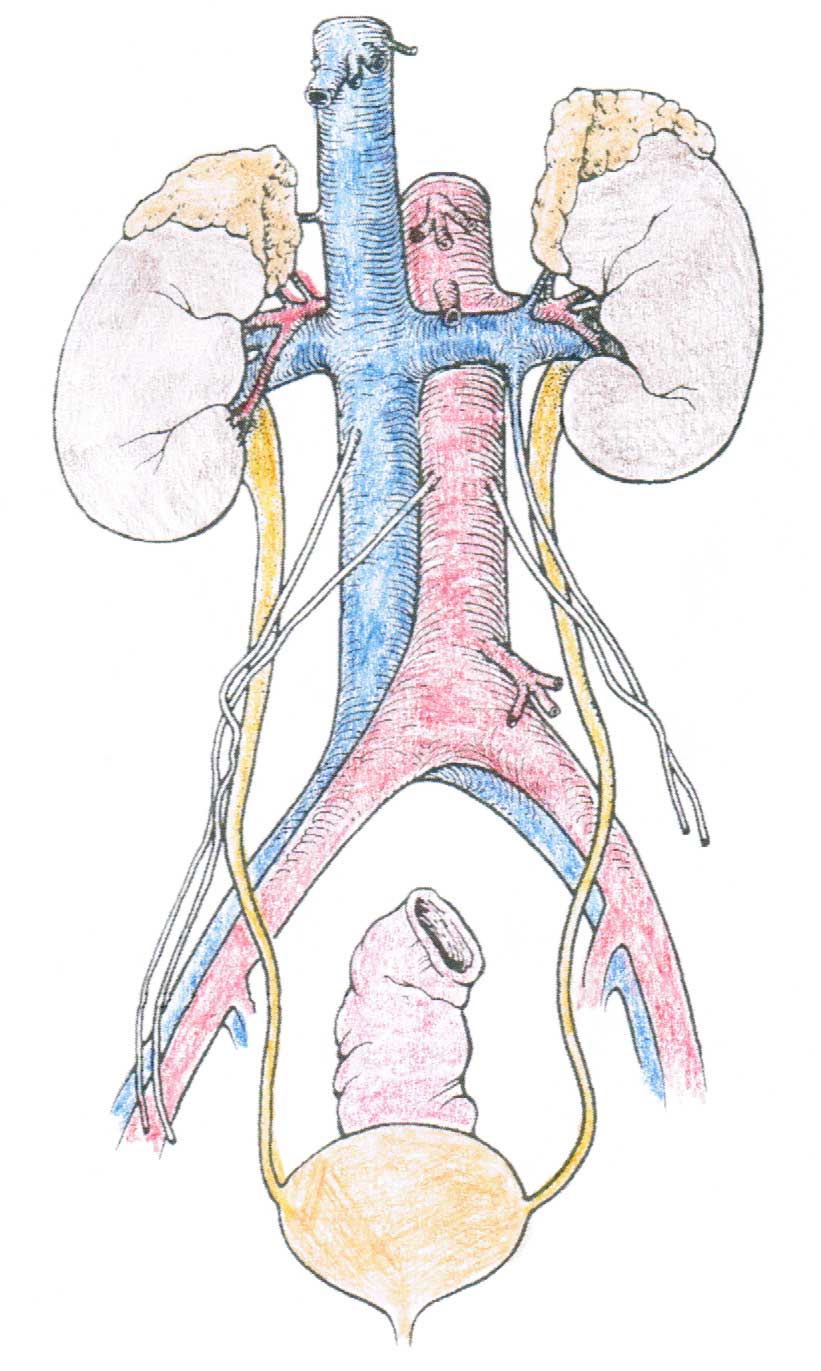
Kidney Anatomy and Function

Kidneys, Ureters, Bladder


This image shows the kidneys, ureters, and bladder. The adrenal glands (part of the endocrine system) sit on top of the kidneys and release renin which affects blood pressure, and sodium and water retention. The bean-shaped kidneys are about the size of a closed fist. They lie against the back of the abdominal wall, outside the peritoneal cavity, just above the waistline in the lumbar area. The right kidney sits slightly higher than the left one because of the position of the liver. The kidneys are aout 4 1/2 inches long and 2 1/2 inches wide. The kidneys are highly vascular (contain a lot of blood vessels) and are divided into three main regions: renal cortex (outer region which contains about 1.25 million renal tubules), renal medulla (middle region which acts as a collecting chamber), and renal pelvis (inner region which receives urine through the major calyces).


The kidneys are protected in front by the contents of the abdomen and behind by the muscles attached to the backbone. They are further protected by a layer of fat.

Kidneys – collect the body’s waste products andUreters – Muscular tubes that transport urine from each kidney to the bladder.Urinary Bladder – A sac that collects and holds urine that comes from the ureters.Urethra – a narrow passageway where urine passes from the bladder to the outside of the body, called urination.

Anatomy of the Kidney

Renal Capsule – outer   membrane that surrounds the kidney; it is thin but tough and fibrousRenal Pelvis – basin-like area that collects urine from the nephrons, it narrows into the upper end of the ureterCalyx – extension of the renal pelvis; they channel urine from the pyramids to the renal pelvisCortex – the outer region of the kidney; extensions of the cortical tissue, contains about one million blood filtering nephronsNephron – these are the filtration units in the kidneysMedulla – inner region of the kidney contains 8-12 renal pyramids. The pyramids empty into the calyx.Medullary pyramids – formed by the collecting ducts, inner part of the kidneyUreter – collects filtrate and urine from renal pelvis and takes it to the bladder for urinationRenal Artery – branches off of the aorta bringing waste-filled blood into the kidney for filtering in the nephrons; the renal artery is further subdivided into several branches inside the kidney. Each minute, the kidneys receive 20% of the blood pumped by the heart. Some arteries nourish the kidney cells themselves.Renal Vein – removes the filtered blood from the kidneys to the inferior vena cava

Every minute 1300 mL of blood enter the kidneys, 1299 mL leave the kidney. and 1 mL leaves as urine.


The kidneys have many functions. The kidneys are the major organs that maintain homeostasis (balance of the various body functions) in the body and help control blood pressure. They maintain balance in electrolytes, acid-base, and fluid in the blood. The kidneys remove nitrogenous waste from the body (creatinine, urea, ammonia) and keep essential substances the body needs to function as it should. The kidneys produce the hormone erythropoietin that stimulates the production of red blood cells and enzymes.


When the kidneys aren’t working as they should, there is a failure of homeostasis which can cause death if not corrected. A panel of blood tests, called a Kidney Function Profile, is used to monitor the kidneys, detect kidney problems or make a diagnosis.

Anatomy of a Nephron


Renal Artery – brings waste-filled blood from the aorta to the kidney for filtering in the nephron. Glomerulus – each glomerulus is a cluster of blood capillaries surrounded by a Bowman’s capsule. It looks similar to a ball of tangled yarn.Proximal convoluted tubule (PCT)Thin descending limb of the loop of HenleThin Ascending limb of the loop of HenleThick Ascending limb of the loop of HenleDistal convoluted tubuleRenal Vein – when filtration is complete, blood leaves the nephron to join the renal vein, which removes the filtered blood from the kidneyArterioles – blood is brought to and carried away from the glomerular capillaries by two very small blood vessels—the afferent and efferent arterioles. Bowman’s Capsule – Surrounds the glomerulusGlomerulus – consist of a the cluster of capillariesProximal Convoluted Tubule – nearest the glomerulus; have permeable cell membranes that reabsorb glucose, amino acids, metabolites and electrolytes into nearby capillaries and allow for circulation of waterLoop of Henle – has an ascending and descending limb, these loops along with their blood vessels and collecting tubes for the pyramids in the medulla. When the filtrate reaches the descending limb of the loop, water content has been reduced by 70%. The filtrate contains high levels of salts (mostly sodium). As the filtrate moves further through the loop, more water is removed which further concentrates the filtrate.Distal Convoluted Tubule - farthest from the glomerulus; helps regular potassium excretion.Collecting Duct – collects the filtrat.


Individual nephrons cannot be seen by the naked eye.


The nephron is the basic structural and functional unit of the kidney. Each kidney has about 1 million nephrons. The walls of the nephron are made of a single layer of epithelial cells. Blood containing urea and metabolic waste products enters the kidney from the liver. The blood is mechanically filtered to remove fluids, wastes, electrolytes, acids and bases into the tubular system while leaving blood cells, proteins and chemicals in the bloodstream. The nephrons also reabsorb and secrete ions that control fluids and electrolyte balance.


The blood enters the kidney and goes to the glomerulus. Pressure forces fluid out of the blood through membrane filtration slits creating a cell-free fluid (plasma) of water and small molecules that enters into the renal tubule. Large cells and proteins stay in the blood. This plasma is taken to the nearest (proximal) convoluted tubule. This runs down into the medulla into the loop of Henle and then back to the farthest (distal) convoluted tubule to join with other tubules. In the distal tubule most of the salts are reabsorbed. What is left is further modified until it becomes concentrated urine which contains urea and other waste products at the end of the collecting duct.The kidneys collect and get rid of waste from the body in 3 steps:

Glomerular filtration – Filtrate is made as the blood is filtered through a collection of capillaries in the nephron called  glomeruli.Tubular reabsorption – The tubules in the nephrons reabsorb the filtered blood in nearby blood vessels.Tubular secretion – The filtrate passes through the tubules to the collecting ducts and then taken to the bladder.The glomerular filtration rate (GFR) is the rate at which the glomeruli filter the blood. The normal GFR is 120 ml/minute. The most accurate measure of the GFR is done by measuring creatinine clearance. Clearance is the complete removal of a substance from the blood. Creatinine is a good measure because it is filtered by the blood but not reabsorbed by the tubules.

Urine is made of water, urea, electrolytes, and other waste products. The exact contents of urine vary depending on how much fluid and salt you take in, your environment and your health. Some medicines and drugs are excreted in urine and can be found in the urine.

94% water3.5% urea1% sodium*.5% chloride*.25% potassium*.25% phosphate.25% sulfate.15% creatinine.1% uric acid

*Electrolytes


What is in urine is not as important as how much urine is made or how the amounts of the individual components change in order to keep the body in balance (homeostasis). This balance is done in the kidneys, no matter how much we eat or drink. The kidneys keep this balance by reworking the blood 15 times a day. If the body is dehydrated, the kidneys put less water is in the urine. When the body becomes too acid, the kidneys remove more acid into the urine. If the potassium levels get too high, the kidneys remove more potassium into the urine.


Urine is formed in the nephrons in three process: glomerlular filtration, tubular reabsorbtion and tubular secretion. The amount of urine varies based on fluid intake and climate.


e-Books Online

What Are The Top 5 Sites Used By Teenagers?

snet

Wow! Its 2013 already! We got through 2012 unscathed and the world did not end, again, as predicted.


2012 was a busy year in the technology space. The use of tablet devices increased dramatically, and that will continue into 2013. New models were seen on shelves that included the iPad Mini. Tablet devices also became more popular in schools.


Internet issues arising in 2012 were mostly the same as the previous year. Cyber bullying being the biggest issue, followed by sexting.


Many schools are spending considerable time sorting out issues arising from what students were saying to each other on Facebook.


Will we see the same issues arising again in 2013? Most likely. Until we build a ground swell for change, from students themselves, issues such as cyber bullying will continue.


After doing some research online, I came across an informal survey carried out by and investor Garry Tan. He asked 1,000 teens what social networking site they liked to use.


Teens love photos but hate text. This is quite evident in the results. Please note that this survey was conducted in the US.


chart


‘What is Tumblr’ you may ask? Tumblr is a micro blogging platform and social networking site. It allows users to post multimedia and other content to a short-form blog. Users are able to follow other users’ blogs as well as make their blogs private.


Like many social networking sites used by teens, Tumblr also suffers from cyber bullying at times. Tumblr can be found at www.tumblr.com


Others you may not be familiar with are Instagram and SnapChat. These are explained below.


An online photo sharing and social networking service that enables its users to take a picture, apply a digital filter to it and share it on a variety of social networking sites, including its own.


Snapchat is a photo messaging application. Users can take photos, record video, add text and drawings and send them to a controlled list of recipients. Users then set a time limit for how long recipients can view their photos, up to 10 seconds. Once the time limit set has expired, the item sent will be deleted from the recipient’s device and the company servers.


SnapChat was only released in 2012. When it came out, there was a lot of negative commentary from internet safety advocates in the US. They claimed that it would encourage promiscuity and lead to an increase in sexting.


However, that is still yet to be proven. We believe it important for parents to be aware of this new technology and have appropriate conversations with their children about it.

Dean Stewart

Dean Stewart is the owner of WebSafety NZ and has over 27 years of experience in the IT industry. His career has taken him to Australia, UK and South Africa, before returning home after a 14 year overseas stint. Outside of work, Dean has two teenage children, is a keen tramper in the outdoors and enjoys growing his own produce.


e-Books Online

The joy of feeling organised when studying

11584426_s

My big fear in 2012 was procrastination. I went back to University after a 30 year break with a sneaking suspicion that I would spend the year cleaning my house rather than focusing on my reading and writing. I am glad to report that I was able to resist shining my windows and spot cleaning the carpet, and I finished the year with a Post Graduate Diploma in Education.


Determined to ignore my drooping interiors for another year I have signed up to complete my Masters in 2013. But as the work gets more complex I need to become a whole lot more organised in my approach. Putting good structures in place right from the beginning of the year will make all the difference to my work this year, as my Professor reminds me.


I know what a difference it makes to students of all ages and stages to get good processes in place right from the beginning. As parents there are a few practical ways we can help our children make a confident start to a new school year. Putting in place systems to help them manage the large amounts of information they will get at secondary school is a valuable way to empower your secondary students. This year I intend to heed my own advice:

Buy a diary and write in all the important dates, especially those where assignment work is due to be handed in.Write in the diary all the tasks I have to complete. Tick them off when they are completed.Buy all the stationery I need at the beginning of the year.Have copies of all the textbooks I will need for the year – try to purchase second hand from older students.Set up a workstation that is tidy, with good lighting, and set in place regular routines for working there.Clean up my laptop. Organise all work into folders and delete what I don’t need.Date all my work so I know which work represents the latest copy of what I am working on.Back up my work and save a copy to Dropbox. Dropbox software can be downloaded for free and work that is saved there can be downloaded from any computer so won’t be lost if your computer is.Complete all written work as carefully as I can right from the beginning so I don’t have to spend hours checking spelling, grammar etc. later on.If I quote another author, I will make sure I write down the source and page number straight away and add it into the bibliography immediately.Ask my teacher/Professor to check my rough copies regularly so I know if I am on the right path or need to make some changes well before my work is due in.

I would have made 2012 a lot easier if I had done these things from the beginning. Good habits are a great foundation for any year and a practical way for us to really help reduce work stress for ourselves and our youth.


The nice thing about a new year is we can begin things differently and perhaps create some more positive outcomes for ourselves and our children in the process.


Have fun getting organised!


e-Books Online

Last Chance $1.99 SALE! Better Than a Box: Transforming YOUR Kitchen into a Real Food Wonder!

Better Than a Box

Ready for some real food magic?

Whether you’re right-brained or left-brained, a scientist who follows every recipe to the pinch or an artist who tosses this spice and that into the pot, you can learn to tweak recipes to make them healthier.

If you love cooking with whole foods but miss your old favorites, this book is for you.

Better Than a Box is more than just a recipe book – it’s a tutorial in real food cooking, reverse engineering processed foods, and creative recipe development.

In the first 100 pages, you’ll learn step-by-step processes to transform your own family-favorite recipes by ditching the boxes and cans and using 100% real food. Through demonstrations of successful recipe remakes and the extensive section of basic recipes, your "Reverse Engineering" toolbox will be well stocked, and you’ll be inspired to take courage in the kitchen.

We leave no can of cream of mushroom untouched.

No box of Stovetop Stuffing is safe.

Buy now to get access to Better Than a Box plus ten additional bonuses, including printable recipe cards and Plan to Eat integration:

How to Transform Your Processed Foods
Recipes into Whole Foods Favorites
by Katie Kimball 
(218 pages + TEN bonuses)

regular price:  $16.95

launch party special, through Friday at 8 a.m. only!

(Don’t forget to download your free gift – Homestyle Chicken!)
Amazon.UK Kindle book

You also might like Healthy Snacks to Go, which is in the hands of over 5000 people, The Everything Beans Book,  Smart Sweets, or The Family Camping Handbook. View them all HERE.

The print version of Better Than a Box should be available Spring 2013.

I’d like to invite you into my busy real food kitchen, where I took a moment away from making dinner for my family to talk about Better Than a Box:

If you can’t view the video, click HERE to see it on You Tube.

20 Reverse Engineering 101 "lab" demonstrations of how I got the processed foods out of favorite recipes and transformed them to whole foods; three of those are Create-your-own 101 with advanced techniques for writing your own recipe from scratch.

35 Remake Resources, the recipes for basic ingredients that you’ll need if you want to reverse engineer your own recipes to ditch the processed foods; things like homemade chicken stock, mayo, BBQ sauce, dressings, bread crumbs, and more. Including…Homemade White Sauce (Cream of "Whatever" Soup) TutorialHomemade Biscuits, Cornbread, Pie crust, Rolls, and CrackersStovetop Stuffing SubstituteVelveeta Substitutes5 Homemade Dressingsa 25% off coupon for Easy. Homemade. by Mandi Ehman …and much more!

25 Ready-to-Cook Recipes, where I’ve done the work for you and you can just pull the recipes out and plan for dinner without having to think through anything. They include prep foods so you know what you need to have prepared, allergy-friendly notes and a section on each one called "Get Kids Involved" to give you courage to invite your little helpers into the kitchen. Including… Dad’s Cheeseburger Helper2 Rice-a-Roni SubstitutesGrandma’s Tuna Noodle CasseroleChicken Pot Pie and Not PieHomemade Chicken NuggetsHomemade Chocolate Syrup…and much more!

MASSIVE Grand Prize, over $400 of real foodie gifts to one winner, plus nine other winners. It’s worth clicking HERE just to see who is involved!!!

When you purchase Better Than a Box here at Kitchen Stewardship, you automatically get the entire Premium Package:

BTAB book 3d best

PDF downloadable eBook, Better Than a Box (218 pages + TEN bonuses)
Better Than a Box is not yet available in print; just on the computer.
Print IS coming Spring 2013!

betterthanaboxkindle

Kindle & Nook files

image

Printable recipe cards
basic pantry staples from the "Remake Resources" section

Access to all the recipes on Plan to Eat
(a 30-day account works to view them, and you’ll also want to be part of the
KS group to see over 30,000 real food recipes uploaded by readers)
To view the recipes on Plan to Eat, click on the link in an email that will come to you within 7 days of purchase (separately from the download email). Do not friend request Kitchen Stewardship.

Homemade Dressings Video Freebie

Exclusive Video: How to Make 3 Salad Dressings from the book
(11 min., my 7-year-old son is featured demonstrating Homemade Ranch)

imageimageimage

FOUR Info Printables: Real Food Substitution Chart, Baseline Fats Chart, How to Cook Dry Beans, Chicken Stock Cliff’s Notes

image

Printable: Freezer Inventory List

How to Transform Your Processed Foods
Recipes into Whole Foods Favorites
by Katie Kimball 
(218 pages + TEN bonuses)

regular price:  $16.95

launch party special, through Friday at 8 a.m. only!

(Don’t forget to download your free gift – Homestyle Chicken!)

See how there are three different kinds of chicken nuggets in that photo? I’m no stranger to adapting recipes for gluten-free and even grain-free. Many recipes include variations to accommodate food allergies.

There are 35 basic recipes + 25 reverse engineered recipes in Better Than a Box. Of those 60 recipes, here’s the breakdown:

Gluten-free: 51 Grain-free: 33 Dairy-free: 27 The sticking point for dairy is the cream sauce – which I understand can be made dairy-free, and there are adaptations in the book, but I still don’t count each recipe as dairy-free because I haven’t tried them all myself. Vegetarian: There are 28 of the 35 “remake resource” recipes that have no meat. In the end section, only 8 of the 25 have no meat, but in 10 others, the meat is ground beef or shredded chicken added to a sauce/pasta/rice. One could cut it out or sub with a vegetarian option.Eggs and nuts make rare appearances but are not frequently used

Ultimately, the first 100 pages are a teaching section that anyone can use to learn techniques from, and the latter half is filled with the recipes. Better Than a Box would still be appropriate for any food allergy.

If you are disappointed in the book for any reason, including that you can’t find enough recipes to fit a dietary restriction, I will refund your money without hesitation. Just email me!

**Note: This eBook will NOT join any “bundle” sales until at least September, 2013.**
How to Transform Your Processed Foods
Recipes into Whole Foods Favorites
by Katie Kimball 
(218 pages + TEN bonuses)

regular price:  $16.95

launch party special, through Friday at 8 a.m. only!

(Don’t forget to download your free gift – Homestyle Chicken!)

1. Do I need a special device to open the eBook?

Not at all. A PDF can be opened on any computer or mobile device. You’ll need Acrobat Reader, which you can download for free right HERE. Don’t forget to save it to your hard drive once you open it.

2. How do I load the files to other mobile devices?

On most tablets, you should be able to download the PDF files directly to your device by clicking on the links in your email confirmation from your tablet. For e-readers and tablets that don’t support file download, simply download the files on your computer and then transfer them via USB cord to your device. **Be sure to read your manual about how to connect and disconnect cords. I cannot be liable if something goes wrong.

3. Can I print the recipes?

Yes! Once the PDF is open on your computer, you can choose just a few pages to print when you find a recipe you want to make. I keep the photos off the recipe pages so you don’t have to waste expensive ink. The document is even formatted so that you can print back to front to save paper, and you’ll be able to put them into a 3-ring binder.

If you love a "real" book, Better Than a Box will be out in print sometime this spring.

4. I can’t see the buy button. What do I do?

Your device needs javascript enabled to see the buy button. If it’s not working and you’ve tried a mobile device and a regular computer, you can just Paypal the cost of the book to kitchenstew at gmail dot come and send me a quick email telling me what it’s for. I’ll deliver your files myself! Winking smile

5. It looks like a blank page when I download. Where’s the book?

When you click the download link, it looks like a blank page, but the eBook is actually downloading in the background. It will go into a “temp” file that may or may not automatically open up for you, depending on your browser settings. Click on your Firefox/Internet Explorer/Chrome icon at the bottom of your screen, and there is probably a new window downloading the book.

6. Can I give Better Than a Box as a gift?

What an awesome idea! I’m totally honored. A lot of the emailing stuff is all automatic, so the easiest thing to do is just forward the download links when you get them. Then you can explain to your friend what the gift is, etc. Thanks so much!

Like with a real book, one book is one book, so if you want a book to keep and a book to give, please purchase two copies.

———————————————

I’d love to see more of you!  Sign up for a free email subscription or grab my reader feed. You can also follow me on Twitter, get KS for Kindle, or see my Facebook Fan Page.

If you missed the last Monday Mission, click here.

Kitchen Stewardship is dedicated to balancing God’s gifts of time, health, earth and money.  If you feel called to such a mission, read more at Mission, Method, and Mary and Martha Moments.

BundleoftheWeek.com, 5 eBooks for $7.40! Print Friendly

View the original article here